
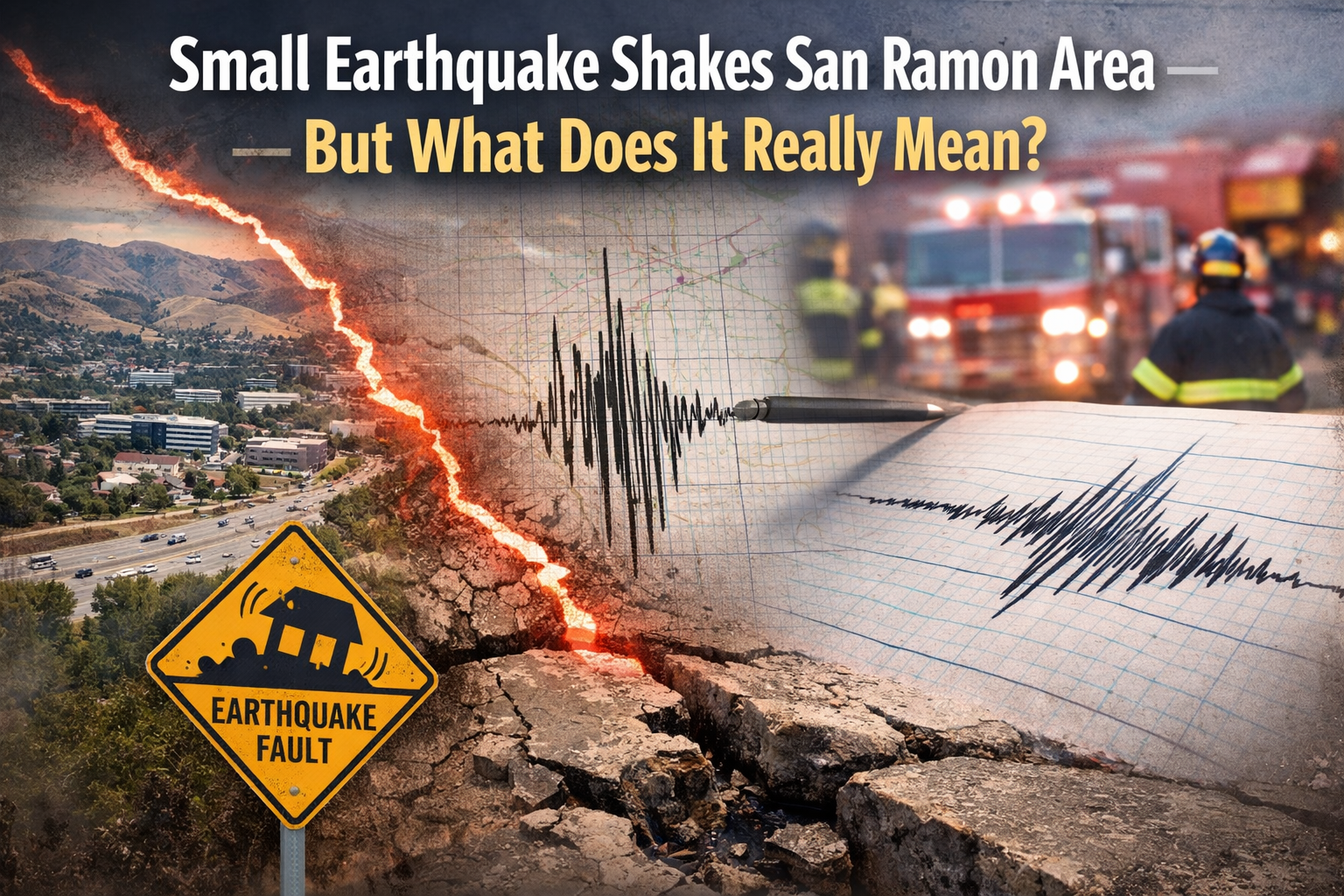
A 3.8-magnitude earthquake was recorded near San Ramon, California, early Monday morning by the U.S. Geological Survey — part of a continuing pattern of tremors that have rattled the East Bay region in recent weeks.
Residents reported feeling shaking in nearby communities, though no major damage or injuries have been confirmed so far. Local officials say such small quakes are not unusual for the Bay Area, but the frequency — not just the magnitude — is stoking public concern.
Earthquake Swarms: Normal or a Sign of Something Bigger?
Many of the recent quakes near San Ramon are part of what scientists call an earthquake swarm — clusters of small tremors without a single obvious mainshock. These can persist for days or weeks.
Scientists generally describe these swarms as “normal seismic behavior,” especially along active faults like the Calaveras Fault beneath the Tri-Valley. But the daily rattling has left some residents anxious and wondering if this could be a prelude to a larger quake — even though experts caution that swarms don’t reliably predict big events.
Why the Controversy? Public Anxiety vs. Scientific Assurance
On one side:
- Seismologists maintain that quake swarms are common and that there is no clear link between small swarms and a major earthquake happening tomorrow.
On the other side:
- Some residents aren’t convinced, pointing to the sheer number of tremors recorded in recent months as unsettling or possibly a sign of “something brewing.” Social media threads reflect this tension, with locals debating if frequent quakes mean elevated risk — or if people are simply nervous because they feel them so often.
That divide — between scientific context and everyday concern — is where the controversy really lies.
Official Guidance You Can Trust
The most authoritative source for real-time earthquake data in the U.S. is the U.S. Geological Survey (USGS):
👉 USGS Latest Earthquake Information – https://earthquake.usgs.gov/
This site offers real-time maps, detailed quake reports, and FAQs explaining what different magnitudes and patterns mean.
For seismic risk probabilities in major California regions:
👉 USGS Earthquake Probability FAQ – https://www.usgs.gov/faqs/what-probability-earthquake-will-occur-los-angeles-area-san-francisco-bay-area?
According to the Uniform California Earthquake Rupture Forecast, the Bay Area has a 72% chance of a magnitude 6.7 earthquake in the next 30 years — and a non-trivial chance of even stronger shaking.
Common Reader Questions (and Realistic Answers)
❓ “Should I be worried that the ‘big one’ is coming?”
Not necessarily right now. Earthquake swarms don’t reliably foreshadow big quakes — but they do highlight that California sits on a network of active faults and that preparedness always makes sense.
❓ “Are quakes getting stronger or just more reported?”
Both factors play a role. Seismic monitoring has become more sensitive, so we detect more smaller events than in past decades. But long-term risk remains real, as California’s fault systems have a long history of moderate to strong earthquakes.
❓ “Should I change my travel or living plans because of these quakes?”
For most people, no — minor quakes happen often with little impact. But those living in quake-prone areas should prepare survival kits, secure heavy furniture, and know how to “Drop, Cover, and Hold On” during shaking.
A Broader Look at Recent Seismic Activity
The San Ramon swarm is just one of many tremors affecting California recently. In the past months:
- Another series of swarms rattled the Tri-Valley, rivaling sequences last seen years ago.
- Other Bay Area quakes, including in Berkeley and the East Bay, have reminded residents that moderate shaking isn’t rare.
- Across the state, clusters of small temblors continue to draw attention as Californians grapple with living above active tectonic faults.
Bottom Line
The recent 3.8 magnitude quake near San Ramon is part of a broader pattern of seismic activity — not a guarantee of a major earthquake imminently, but a compelling reminder of California’s restless geology. With real risks identified by the USGS, ongoing education and preparedness remain the best response to living in this dynamic environment.
Leave a Reply